Retinol is everywhere: serums, night creams, eye creams, even body lotions. The message is often that once you pass 35, you should be using it. Retinol does have strong evidence behind it, but “effective” is not the same as “essential”. Here is what retinol does, who benefits most, the real risks, and how to start without damaging your skin barrier.
What retinol does
Retinol is a form of vitamin A and part of a family of ingredients called retinoids. Most skincare ingredients work on the surface: moisturisers add water, oils soften, ceramides support the barrier. Retinoids are different. Once absorbed, they are converted into retinoic acid, which changes how skin cells behave.
- Faster cell turnover. Older surface cells are replaced more quickly, so skin looks smoother and brighter.
- Collagen support. Long-term use helps the skin produce collagen, which softens fine lines over time.
- Clearer pores. Retinoids regulate how skin cells shed inside the pore, which is why they also treat acne.
- More even tone. Faster turnover helps fade dullness and some uneven pigmentation.
Retinoids are among the most studied topical ingredients for signs of ageing, recognised by dermatology bodies such as the American Academy of Dermatology. That is also why they can cause side effects: an ingredient that changes how skin works can also irritate it.
Do you need retinol after 35?
No, not automatically. Prevention is not the same as necessity.
The biggest drivers of visible skin ageing are UV exposure, smoking, chronic lack of sleep and pollution. Someone who wears sunscreen every day for a decade will often see more benefit than someone who uses a strong retinol but skips sun protection. If your skin is healthy and you are happy with it, a good routine of gentle cleansing, moisturiser and daily sunscreen may be all you need.
Who is likely to benefit
- People with fine lines, rough texture or dullness they want to improve
- Those with acne, blackheads or frequently clogged pores, at any age
- Anyone with a stable routine who already wears sunscreen every day
Who should wait or avoid it
- Anyone pregnant, trying to conceive or breastfeeding
- People with rosacea, eczema or a currently irritated, damaged barrier
- Anyone who is not willing to wear sunscreen daily
Does retinol make your skin thinner?
This is a common worry. Used correctly over the long term, retinol does not weaken healthy skin. Research suggests it can actually thicken the living layer of the epidermis and support collagen.
The short-term picture is different. In the first weeks many people go through “retinisation”, an adjustment period that can bring:
- Dryness and flaking
- Redness and stinging
- A tight, sensitive feeling
This usually settles within a few weeks as the skin adapts. It lasts longer, and feels worse, in sensitive skin or when retinol is combined with other strong actives. Peeling is not a sign that it is working better; it is a sign to slow down.
Can retinol cause melasma or dark spots?
Retinol itself does not cause melasma, and retinoids are sometimes part of pigmentation treatments prescribed by dermatologists. The real risk is post-inflammatory hyperpigmentation: dark marks left behind when skin is irritated or inflamed. This is more likely in medium and deeper skin tones.
Two habits prevent most of it:
- Go slowly so your skin doesn’t become inflamed.
- Wear sunscreen every morning, especially on the cheekbones and forehead. Freshly renewed skin is more vulnerable to UV.
How to start retinol safely
- Choose a low strength. Around 0.1% to 0.3% retinol is a sensible starting point. Gentler forms such as retinyl esters or granactive retinoid suit sensitive skin.
- Use it at night only. Light breaks retinol down, and evenings give skin time to recover.
- Start two or three nights a week. Increase to every other night, then nightly, over several weeks if your skin is comfortable.
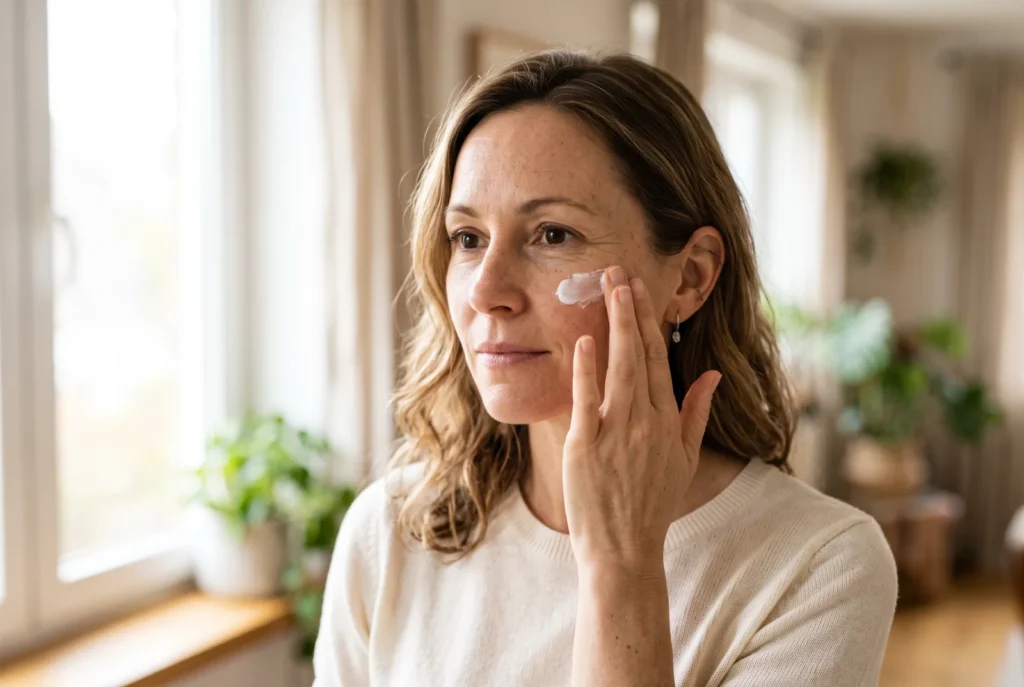
- Use a pea-sized amount for the whole face. More product means more irritation, not faster results.
- Apply to dry skin. Damp skin can increase absorption and irritation.
- Buffer if needed. Apply moisturiser first, or use the “sandwich” method: moisturiser, retinol, moisturiser.
- Keep it away from the corners of the nose, the lips and the inner eye area.
- Don’t combine it with exfoliating acids (AHA, BHA) or strong vitamin C on the same night.
- Wear SPF 30 or higher every morning.
- Be patient. Visible changes to texture take around 8 to 12 weeks; fine lines take longer.
The real problem: how people use it
Retinol rarely fails because it doesn’t work. It fails because of how it is used:
- Jumping to a high strength too quickly
- Using it every night from day one
- Adding exfoliating acids, scrubs and other actives at the same time
- Treating peeling as proof that it is working
- Starting it simply because it is popular, without a clear reason
Ageing is natural. Good skincare supports healthy skin over the long term; it doesn’t need to be a constant fight against every line.
The takeaway
Retinol is one of the few anti-aging ingredients with solid evidence, but it is not compulsory after 35. Daily sunscreen, enough sleep, a healthy skin barrier and a simple routine often matter more. If you do want to add retinol, start low, go slowly, protect your skin from the sun and give it time.
This article is for general information and is not medical advice. If you are pregnant, breastfeeding or have a skin condition, speak to a doctor or dermatologist before using retinoids. Written with reference to a beauty knowledge article published by Beauty Review (beautyreview.co).